
OpenSSL Debian seeding problem – what a mess – installing the update itself is trivial, but the sysadmin time is in having to chase down and remove and regenerate weak keys generated by multiple packages, which in turn can have propagated to multiple machines, generated any time over the last year and a bit on a Debian or Ubuntu system. Ouch. Most helpful resource for doing that is the SSLKeys page on the Debian wiki.
Category Archives: SLUG
Proof of bot status
A few days ago, I saw this comic:

…. and then today I tried to register for a forum, and got this:

… and clicking “Refresh Image” gave this:

… and of course I thought of the comic.
Sydney BarCamp 3, day 1 notes
My quick notes from the first day of Sydney BarCamp 3 – apologies if they are quite terse:
- Making computing cool – Let’s make everything objects, and hide file systems and devices from applications, with an on object layer. Benefits in reducing all the glue everywhere when communicating data over the wire or between apps; Could also allow apps to be migrated from one machine to another; Could even have a login of standard apps that follows you everywhere via the cloud., including retained state from your last login, but without using something like Citrix.
- Processing and the demo scene. Gave a background to the demos and the demoscene. Introduced processing, which is a Java-based tool, built by 2 guys who have been working on it for about 4 years. Artists are one of the target audiences. More info at http://processing.org.
- Sydney free wireless project. Currently trying to work out what standard hardware to use for the city-wide mesh, now that there are concerns over Meraki becoming much less open and losing their way (who have introduced a more restrictive EULA and have made flashing the hardware much harder). Open mesh dashboard is an open fork from Meraki, but still need to sort out a reasonable cost for the hardware including shipping to Aus. Also want the mesh to interoperate with other meshes – e.g. want to be able to automatically connect this mesh and an OLPC mesh, if at all possible.
- Spoke to someone using 3 mobile networking on their laptop – uses a PC card with HSDPA. Recommended it, $15 per month for 1 Gb, or $49 for 5 Gb, and the modem is ~$298, or free if you sign a 24 month contract. There is currently a price war going on between Vodafone, 3, etc. over mobile broadband, prices are improving.
- Quotes: “The problem with Domain Specific Languages (DSLs) is that they are Domain Specific”. “The tipping point for data portability is the user expectation of having data-portability between web apps.â€
- Some lessons from a start-up biz:
- Advertising is useful. Measure it carefully.
- Tech roadmap is about PR – tells customers “what’s coming next” – you need one – not binding – “announce before you announce”.
- Take a punt on marketing. Hard work getting the word out about your product. You have 9 lives when marketing – one failure won’t kill you.
- Make mistakes properly. Failing is okay, but do it properly. Fail in spectacular fashion.
- Everything takes longer than you think. It’s true.
- Be unconventional.
- Q: What mistake cost the most time? A: Messing around with landing pages. Company wisdom is that you should make a lot of them and test to see what is most effective. Need a lot of volume to perform useful tests. A case of premature optimisation.
- Q: Do we need to talk a lot of lawyers and accountants at start-up? A: No, not when in the initial stages. However when you have worked out what your idea is, and have money coming in, then need to talk to both. But be aware of the risks.
- grails – previously called “groovy on railsâ€. Person now working on getting http://memsavvy.com/ off the ground. Grails is based on Java. (Java, spring, hibernate and Apache app.) Grails currently has 63 plugins (one for adding search, one for web objects, etc.). Grails solves a technical problem. An out-of-the-box MVC system. Sky.com, using grails, serving 186m pages/month.
- A business owner is 3 people: 1) Entrepreneur 2) Manager who keeps the biz afloat 3) Technician who built the product
- “Start-up kitchen” is a start-up incubator. It provides a practical solution to continuous cash flows. Has an office in St Leonards. For start-up cash flows, you are hired in a part-time way (2 or 3 days a week) (work depends on the skill set that someone has; may be internal work; or external IT shop work for blue-chip clients), which gives you cash flow.
- “Talking to rich guys”. (about what angel or VC people are looking for in a company). Investors want a biz capable of $100m of in 4 to 5 years. In the valley there are lots of VCs. In Australia, not so much – want to do late stage buyouts and make money charging fees to a company. There is plenty of money available; there are just not enough REAL businesses that can make good use of that money. As a rule, investors don’t like software, or web apps. To get in front of a dozen to 50 rich people, need to have a good story (need a business, a real business). Most Australian angel investors are retired or semi-retired engineers who love gadgets. For the first 100,000 units want to manufacture locally. “IM†is an information memorandum – like a prospectus, but a lower standard (because is not covered by regulations). Example: A company is looking for $1m. Angels want 35% ownership of the company, but will rarely get it. (Investment range of 200k to 500k is angels, and $1m + is small institutions). Watch out for fees – e.g. one guy wanted 250k in fees to raise 500k. Brains are the cheapest thing you can buy. E.g. “women on boards” who want a paid position on boards – e.g. 35k per annum, and for this they would have to go to 8 meetings per year, and are personally liable for the business if anything goes wrong. Women are much cheaper than blokes (there are institutionalised problems for women in business trying to get equal pay). Anything above this, pay cash-in-hand $100 per hour. To get money have to be able to give a good answer to “WIT FM?” for the investor – “What’s In It For Me?”
- Good places to get stock photos for $1 or $2 a pop: istockphoto.com or luckyoliver.com
- BarCamp Canberra is on in 2 weeks. (sat 19th April).
- Sociability design. This is like usability design for applications – which is making the app as usable for your user as possible, so that it is pleasant and intuitive to use. Sociability design is making a socially useful system, such as social sites like LinkedIn, Facebook, and MySpace. There are parallels between usability – especially Jacob Nielsen’s 10 main types of usability – and the basics of how you make a pleasing social user experience. Table of comparisons. The speaker’s blog. The language used to describe relationships needs to be richer, whilst still being diplomatic.
- Open coffee – a coffee meeting for people starting up. Runs every second Thursday.
- Twitter – got a quick intro to this. 140 character microblogging / updates. Max of 240 free SMSes per week in Australia.
- The bar opened, and I played 3 rounds of the Werewolves + Seekers + Healers + Villagers game (rules are here or here, we played with a healer), which was a fun social game. There were between 11 and 15 people at the start of each round. It just confirmed what I always known – that I am a really bad at deception – I was found out fairly quickly when I was a werewolf!
ABC video downloads seem quite low res
It’s great that I can legally download ABC shows that I missed directly from their website (e.g. Sunday’s first so-so episode of East of Everything). However the video resolution seems quite low, at 320 x 180. Can’t we at least get a download that’s bigger than a postage stamp? For comparison purposes, on a 4:3 CRT TV, a 45 minute XviD at 624 x 352 is completely watchable, and has a file size of 360 Mb (versus 188 Mb for the ABC video at 55 minutes long). So, for around twice the file size, it becomes significantly less blurry and more pleasant to watch, and therefore more useful. Isn’t it at least worth giving the option of the bigger download, for people that aren’t watching on a small screen portable device, like an iPod or mobile phone? Hopefully ABC playback (which is now in a by-invitation beta phase) will offer much higher resolutions. However, downloading an hour-long video is far preferable to watching it in a browser using flash, in my personal opinion – although I can see that the ABC might be concerned that this could cannibalise sales of DVDs through ABC stores.
LCA2008 talk: “Who’s behind Wikipedia?”
Today I’m at Linux.Conf.au 2008 in Melbourne, where Brianna Laugher gave a talk called “Who’s behind Wikipedia?”
If I find the link to the video I’ll add it here, but in the mean time my quick notes from the talk are as follows:
Firstly, selling Wikipedia to geeks is an easy sell.
Brianna’s background: free content, rather than free software.
Talk assumes familiar with Wikipedia, and is for people who believe that the Wikimedia model can work. Not for conspiracy theorists, or people who think the model does not work.
What is Wikipedia? World’s largest grass-roots bureaucracy! 253 languages (145 have > 1000 articles), > 8 million articles total. Multilingual project.
Early timeline:
- 2001 – Wikipedia
- 2002 – Wikitionary
- 2003 – Wikimedia foundation formed.
Will focus on the English Wikipedia. Different cultures will have different issues. E.g. Japanese Wikipedia has 45% of edits made by anon users, nearly twice that of English, which probably creates a very different culture in that project.
Wikipedia community : Hierarchy / diagram of User access levels, roughly from largest groups to smallest groups:
- Readers
- Anon editors [can’t upload files or start articles, depending on config]
- Registered users (6 million accounts, but a very large percentage never edit) [subdivided into new and auto confirmed]
- Roll-back [hundreds of accounts]
- Administrators / sysops [delete pages, protect pages, block users, approx 1500 on English, admission via RFA process]
- Bureaucrats [26 people] / arbitration committee [12 people] / checkuser [30 people] / oversight [27 people] / WMF board and staff / Jimmy Wales [founder] / developers / stewards
Wikimedia Foundation – provide essential infrastructure and organisational framework (i.e. part of function is glorified web host + enforce legal constraints to keep project running). Listed some of the WMF projects (wikibooks, etc.)
Some cornerstone guidelines:
- Assume stupidity over malice / assume good faith.
- NPOV
- Copyleft
- consensus decisions
- no ownership
- incremental progress
Policies:
- a very long list! (e.g. 3RR, sock puppetry, verifiability, Biography of Living people, no personal attacks, WP:NOT, protection / semi-protection, ignore all rules).
Guidelines:
- Another very long list! (e.g. don’t bite the newbies, WP:POINT, spoilers, spelling esp. British versus American).
Showed some tags that may be added to new articles, that new users may come across:
- Speedy deleting
- Proposed deletion
- Normal / Article for delete (5 days of discussion).
- –> How to defend “your” article: Improve it!
If concerned about undeletion of content added:
- Try to resolve with deleting admin
- Esp. when notability has changed, or inappropriate speed, or process not followed.
- Two useful pages related to undeletion: [[user:GRBerry/DRVGuide]] and [[WP:ATA]]
Dispute resolution:
- Be bold, revert, discuss
- Talk pages
- [[WP:RFC]] (comment)
- [[WP:RFM]] (mediation)
- [[WP:RFAR]] (arbitration – more formal and serious; need to provide evidence and reasons, etc.).
How to get involved:
- [[WP:AWNB]] – Australian’s Wikipedian noticeboard
- WikiProjects (there are projects covering most hobbies).
- Don’t leap into controversy, but do leap in. (e.g. don’t start out with Israeli Palestinian conflict, abortion, Linux Versus Microsoft).
- WikiChix.org for female contributors.
- Don’t worry about reading all the rules and documentation, just do your best. (instruction creep).
The future:
- WYSIWYG editing, maybe!
- Stable versions.
- Trust highlighting.
- Splintered community (old hands versus newcomers)
- Knol, Citizendium (expert-model versus the Wikipedia model). Also Citizendium looks like will use CC-SA license, which is good.
Audience Questions:
- Q: Are Wikia and Wikipedia separate? A: Yes.
- Q: If I see errors, can I fix them? A: Yes, please be bold and correct inaccuracies, or if pressed for time, then delete the wrong information and add an explanation in the edit summary.
- Q: Would like to be able to download Wikipedia images (and especially the image dump), last image dump was from 2004, and want a new one. A: The database dump and image backup process is something that is an item of community concern, and is being worked on.
- Q: Putting Wikipedia into book format. A: Spoke about PediaPress.
- Q: Notability, can this be determined by number of hits on a page? A: Yes and no (e.g. some topics can be obscure, yet notable).
- Q: Growth of the Wikipedia? Exponential growth versus Linear, which is currently being experienced. A: A lot of growth is in the non-English-Wikipedia areas, although does not have latest data.
- Q: Is Wikipedia too focussed on current events? A: Maybe, although there has a been a shift towards a longer-term view.
I vote holiday!
Just back from a week’s holiday blissing-out in Tonga, on a postcard-perfect tropical island surrounded by coral.
Fortunately this meant I missed the end of the Australian Election (yay!), and got to vote early (highly recommended – much calmer and less fuss than doing it on polling day) so as to satisfy Australia’s compulsory voting requirement (and avoid the fine if you don’t vote).
Our flight to Tonga was delayed by 3 hours, as an 83-year-old on the plane’s inbound flight had died half way through the flight, so a number of ambulances and police cars pulled up at the gate when it arrived and the passengers were not able to leave until the paperwork had been processed. This meant we arrived in Tonga at about 1 AM, and got a boat to the island in the middle of the night, and arrived at about 2 AM.
Our fale (Tongan word for hut or house) was great; it used a traditional design largely open to the tropical air (good) and the mosquitoes (bad). Lots of space and privacy though. Map of Fafa island. There was no Internet, no phones in the room, no newspapers, no radio, no TV … love it! And the food was superb – there was fresh delicious seafood every day – especially lobster and fish – all locally caught daily from the surrounding ocean, and often cooked in coconut milk and served with rice. I gained about 2 kilos in a week!
I have to confess to being a total wuss when it comes to deep water and big sharks (I should never have watched Jaws, or Open Water). However, I deeply enjoy snorkeling coral reefs, and seeing smallish sharks in the wild. So when Rebecca saw a 1-metre Blacktip reef shark attacking a school of small fish a few metres out from the shoreline, I just had to go in and see if I could watch it up close. So put my mask and fins on, and swam out about five metres and stopped in the middle of the school of fish. The water was cloudy from all the sand stirred up in the water from the waves on the shore, so I spent about three minutes carefully looking to the left, looking to the right, looking straight ahead, before concluding that it wasn’t there any more, and swimming back in. I stood up and yelled “It’s not here any more – sorry, no shark!”… And then I noticed that Rebecca was wildly pointing and hopping up and down with frustration, and she told me that just after I had swam out, the shark had done a big circuit around me, and then had stopped dead in the water a few metres behind me with its dorsal fin sticking out of the water, and had just studied me for a few minutes as I was looking around, and had then swam off when I started turning around to swim in. And who says sharks don’t possess a sense of irony?
Then on the daytime flight back to Sydney, we had a great view of the North Minerva Reef. I forgot to take a photo: sorry! However, this reef looks fantastic, and also rather out-of-place. It’s roughly 500 kilometres of open Pacific Ocean away from the nearest land, surrounded by pure deep blue ocean, and then in the middle of the open ocean there’s this circular reef all by itself, with no land or islands anywhere to be seen. The quality of the diving and snorkeling must be amazing – with that much distance to the nearest land the visibility would be stunning, and there would be no pollution, and hopefully few enough visitors to keep it pristine. The pilot described it thus: “The Minerva Reefs are a great place for yachties to be when the weather is good. However, you really want to avoid it when the weather turns bad”. Sounds interesting – if I ever get a chance to go there, I think I’ll have to do it!
Location-aware wikis – the next big wiki thing?
There are some important changes coming in the next five years around how people will use wikis, specifically in conjunction with mobile devices. I’d like to publicly outline my thoughts on the background, the premise, and the potential.
Background
First some background. Around 4 or 5 years ago, most laptops started including local wireless and better power-saving as standard (i.e. greater portability of computing power). About 2 years ago, the number of laptops sold exceeded the number of desktop and server systems sold, and that trend has only continued since (i.e. greater ubiquity of portable computing power).
About 12 years ago, the first mobile phone I owned was a second-hand classic Motorola the size and weight of a small brick (it was too heavy to carry often, so mostly I left it in my car – it was similar to this, but a bit smaller – it was mobile, but not wearable, and the battery life was rubbish, maybe a few hours, and it could only do phone calls). About 9 years ago my phone was basic Nokia – it was much lighter, with battery life of a bit over 1 day, but it was still a bit heavy so it had a belt clip, and it could make calls and send SMS (i.e. very basic data). My current Nokia phone is about 4 years old, it’s cheap, it’s lightweight (85 grams), it has battery life of about a week, and it does WAP, but no Wi-Fi. So the trend lines are clear in retrospect for both laptops and mobiles, and looking ahead, they are converging: Greater portability; Greater computing power; Greater battery life; Greater access to mobile data; And mobile phones are basically becoming wearable mini-computers that you carry around in a pocket with you.
The premise
So far, this hasn’t impacted wikis too much, but I think we’re about to reach a tipping point where these trends do have a bigger impact on wikis – I would like outline why, and what’s required for it to happen. In particular, lately a number of friends and family have independently upgraded to mobile phones with inbuilt GPS plus mobile Internet functionality. I think GPS + mobile Internet + wikis could be a game changer, and it could be a seriously kick-arse combination. But you need all 3 components for it to work.
Think about it – a wiki that has local information about your area, the best restaurants, the best sights and entertainment, all with genuine user-comments and guides and feedback and ratings. Everything in that wiki is geotagged – that’s part of the core purpose of the wiki. You “carry” the wiki with you in your pocket, on your phone, through your mobile Internet. And as you move around, the GPS shows you where you are, and what’s near to you that has got articles and that was good. Wander wherever you like, knowing that you’ll always have the best low-down on what’s good and what’s not, no matter where you are. Be a local anywhere.
Now the mobile phone manufacturers have already started to include some limited GPS software with “points of interest” on their phones – e.g. the Nokia Navigator 6110 will show you nearby ATMs, petrol stations, public bathrooms, etc. That’s great for facts for commodity destinations (e.g. most ATMs or Petrol stations are completely interchangeable). But what about restaurants – which ones are worth eating at, and are in your budget? Sights – which ones are actually worth seeing, according to the people that have been there? The currently GPS software lacks depth in this regard, but worse it lacks participation. This makes it broken.
There are audio tour guides starting to show up for cities – e.g. in Hong Kong you can purchase a SIM card which would then give you free over-the-phone access to a canned tour guide you can listen to as you wandered in a certain area of the city. But it’s basically scripted for you, and you don’t get to “edit” it to add your picks for those who come after you. Canned audio guides lack interactivity and participation.
There are some city-specific wikis (e.g. DavisWiki, ArborWiki), which have good depth about an area. But mostly they lack geotagging, and there’s bound to be some server-side software updates needed to make location-aware wikis work well on mobile phones. So currently the wikis we have about a specific location aren’t particularly usable from a mobile phone. They’re about a place, but they are not location-aware or portable. As a result, city-specific wikis have been a niche wiki application, but in a few years the number of wikis in this area will explode. I know that a number of entrepreneurs are interested in local wikis or the data stores behind them, and it’s an area that has a huge and largely untapped potential, but which to date has mostly been done well by transitory college students.
There are some sites (e.g. for New York) where you can get functionality something like what I’m describing (by scribbling notes on a map), but I suspect it’s not as deep or as broad or as structured as a wiki can be.
No, what you need is all 3 things together: The location-awareness of GPS, the depth and timeliness of being able to access a great big store of current information via the Internet, and the participation of wikis. But it will happen. I’m calling it – mark my words. And whoever does it first and does it best will probably make a bloody fortune.
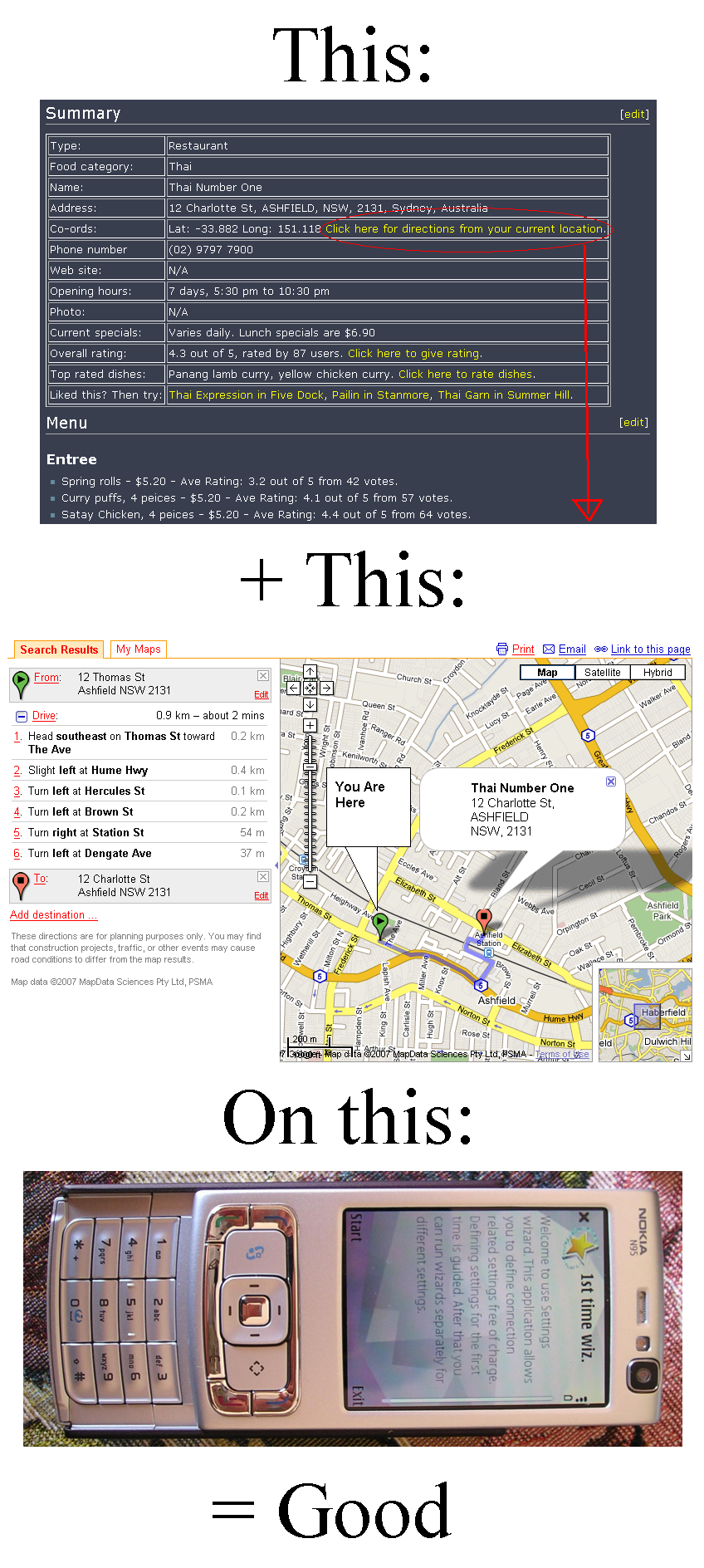
The problems
What’s holding it back currently is that advanced phones are expensive (e.g. about AU $850 for a Nokia N95, but there is at least one open-source phone which will have GPS called the OpenMoko in development), not all phones have GPS (e.g. the lauded iPhone lacks GPS – what were Apple thinking? – wouldn’t buy one of these until it has GPS if I were you), and mobile Internet is expensive and often usage-metered rather than flat rate. But those things will get fixed in time. The technology exists and works – it just needs to become widely distributed. Mobile Internet will become ubiquitous in phones, even the cheap ones. GPS will become ubiquitous in phones, even the cheap ones. And mobile Internet will get cheaper as demand for it increases and competition increases, or it will be overtaken by citywide mesh wireless networks. These things will happen, and the opportunity is very real. So it’s not an “if” but a “when”. I’m thinking maybe 5 years before it’s common to see people in the street doing this. But if you want to be there and be ready for that time in 5 years, you probably need to start building it now. But the building it will probably be expensive, simply because the first one of anything non-trivial in software usually is expensive.
What will it look like? How will it work?
The first thing to realise is that if you’re walking around, you don’t normally want a lot of text. A 40-kilobyte Wikipedia article is a tad unwieldy to read on a 2.6″ screen whilst walking around in the full sunlight. What you want instead is a summary of information, possibly spoken by software instead of written text. A little bit of the right information at the right time: “Turn left here. Walk 50 metres. It’s nearly lunchtime – Excellent Portuguese Chicken on your right for $10”. Keep it simple, keep it short.
Now if people want more information at that point, then give it to them. “Hmm… Portuguese food… yum, sounds tasty… let’s quickly scan the menu and ratings… **click** **scroll** … okay, sold!”
Now it’s not a wiki unless you can then add your thoughts. So after you meal, you notice that the hours are slightly out of date, and correct them. Maybe you upload a photo of the shop or your dish (before you ate it!). And you add a rating (4 out of 5) and a quick note: “the chicken is succulent and tasty. Be sure to ask for garlic sauce on your chips – it tastes great!”
Another thing you could do is follow a planned route if you’re new to an area, for a “best of” tour. This is kind of like the Hong Kong idea, but because it’s a wiki it could evolve and be updated in a decentralised fashion. Similarly planning your own routes for later, and storing them on the wiki, would be good. And after you had done the route, if the wiki asked you whether you had any corrections or updates that you wanted to make, then that would be good.
There will also probably have to be a more traditional detailed way to view the wiki, like the standard Wikipedia Monobook skin. This would allow both mobile and desktop users to update and edit the site, whilst still allowing mobile users to have a more concise view of the information.
An important thing to note is that most of the content has to be created by locals. Someone on the other side of the planet can add skeleton entries for restaurant or parks or museums such as names and addresses, but the valuable content, the user-generated stuff, has to come from ordinary users, on the ground, who know the place in question, have tried it, and have had some sort of reaction. So a low barrier to entry (much lower than the Wikipedia) is required to allow sufficient people to contribute feedback to allow it to work.
How to make it happen faster
The single best way to help make this happen faster is to build citywide free mesh wireless networks in your neighbourhood. The mobile Internet is the biggest stumbling block, and big telecoms are hugely resistant to change or dropping their prices unless forced to (basically, they’re pricks). GPS in phones is coming, and I see no sign that companies like Nokia are holding back; and wiki people generally don’t hold back, so that doesn’t worry me either. The wireless networking does a bit though. The answer may be to build a grassroots network, using a self-healing easy-deployment wireless mesh, such as Meraki is doing in San Francisco. (By the way, if anyone wants to start making one of these mesh networks in Sydney, let me know, I’d happily be involved in that).
Anyway, that’s it from me. Just remember: GPS phone + wireless Internet + local wikis = perfect storm. Ciao!